Medical Environments
What medical applications are TechniQuip’s light engines used for?
TechniQuip’s illumination solutions are primarily used as OEM light sources within advanced medical imaging, diagnostic, and surgical systems. Their light engines support applications such as endoscopy, laparoscopy, colonoscopy, surgical microscopy, retinal imaging, ophthalmology, and surgical robotics, where high brightness, excellent color rendering, fiber-optic coupling, and reliable long-life performance are critical.
These applications represent some of the fastest-growing opportunities as medical and life science OEMs transition from legacy lamp technologies to intelligent LED illumination architectures.
How do you achieve repeatable illumination in regulated medical environments?
In regulated medical environments, repeatable illumination is not simply about generating light—it is about delivering the same optical performance every time, across every instrument, throughout the product lifecycle. Whether the application is fluorescence imaging, surgical visualization, ophthalmic diagnostics, flow cytometry, or molecular diagnostics, illumination variability can directly impact image quality, measurement accuracy, diagnostic confidence, and ultimately regulatory compliance.
TechniQuip’s solid-state LED illumination systems are designed to support repeatability through:
- Calibrated light output to ensure each system delivers consistent illumination across inspections, devices, and time
- Stable and uniform light intensity, minimizing variation that could impact imaging accuracy or measurement results
- Precise control over wavelength, intensity, and timing, enabling predictable performance in advanced imaging and diagnostic systems
- Field-configurable and application-specific calibration, allowing OEMs to tailor illumination to specific systems and maintain consistency over the product lifecycle
- Long-term reliability of LED sources, reducing drift compared to legacy lighting technologies and supporting consistent operation in regulated environments
Repeatable clinical results begin with repeatable illumination. The most advanced imaging system can only be as consistent as the light source driving it. TechniQuip’s HelioLux LED illumination is CE certified and UL classified for safety and usability as part of a medical system.
LED vs. Legacy Illumination for Medical Devices
Are LED microscope illuminators more consistent than halogen for Medical Device QA inspection?
Yes. LED microscope illuminators are generally more consistent than halogen lighting for QA and inspection applications. Solid-state LED light engines—like those developed by TechniQuip—are designed to deliver stable, uniform, and repeatable illumination, which is critical for quality control and imaging accuracy. Unlike legacy halogen systems, LED illumination offers more reliable performance over time.
TechniQuip’s LED light engines are specifically engineered for applications requiring high precision and repeatability, including medical diagnostics, microscopy, and automated inspection systems.
What are the tradeoffs between halogen, xenon, and LED light sources in medical devices—and which is most common?
Halogen, xenon, and LED light sources each offer distinct tradeoffs in medical and surgical illumination, but the industry has largely shifted toward LED (solid-state illumination) as the modern standard due to its performance, efficiency, and reliability.
LED v Halogen v Xenon Lamps in Medical Devices
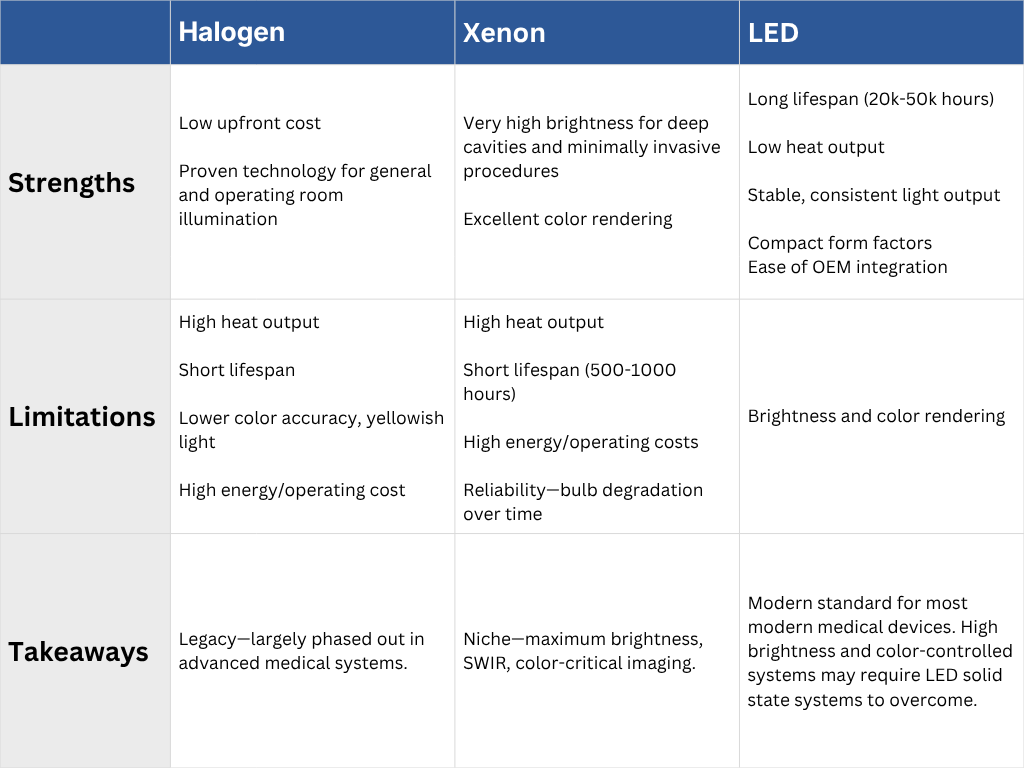
LED is the modern standard for light sources in both medical devices and operating rooms. TechniQuip combines LEDs and fiber optics into a solid state LED light engine to achieve brightness >5000 lumens and a color rendering index >92 CRI in a compact form factor ready for system integration.
Which illumination parameters impact diagnostic accuracy?
The illumination that delivers the highest diagnostic accuracy is stable, high-CRI, wavelength-controlled LED (solid-state) illumination with uniform and repeatable output. In modern medical imaging, diagnostics, and surgical systems, illumination is a critical parameter that directly affects image clarity, contrast, and measurement reliability.
TechniQuip’s LED light engines are designed to optimize diagnostic performance through:
- High color rendering and spectral control, enabling accurate differentiation of tissue, materials, and biological features
- Stable, flicker-free light output, which ensures consistent imaging results across time and systems
- Precise wavelength selection and tunability, improving contrast and enabling fluorescence-based or multi-spectral diagnostics
- Uniform illumination, reducing shadows and artifacts that can interfere with interpretation or automated analysis
- Repeatable, calibrated performance, which is essential for regulated environments and quantitative diagnostics [techniquip.com]
In diagnostic systems, from retinal imaging and endoscopy to flow cytometry and live cell imaging, these factors ensure that illumination is not introducing variability or bias into the imaging system. Well designed, purpose-built illumination becomes a controlled, validated input that supports accurate detection, measurement and clinical decision making.
Medical Device Inspection
What illumination technologies help medical device manufacturers reliably detect defects, contamination, scratches, and particulates while maintaining inspection repeatability and regulatory compliance?
The most effective lighting for detecting defects, contamination, scratches, or particulates in medical products is high-intensity, uniform LED illumination with precise wavelength control. In medical device manufacturing and diagnostics, illumination must reveal very subtle surface and material variations without introducing variability into the inspection process.
- Uniform, repeatable illumination, ensuring defects are consistently visible across different inspections and production runs
- Narrow wavelength and spectral control, which enhances contrast and helps highlight material differences, fluorescence, or contamination
- High-intensity, directional lighting, making small surface features like scratches, particulates, and micro-defects easier to detect
- Stable and calibrated output, enabling reliable QA processes and compliance in regulated environments
- Compatibility with machine vision and microscopy systems, improving automated inspection accuracy and repeatability
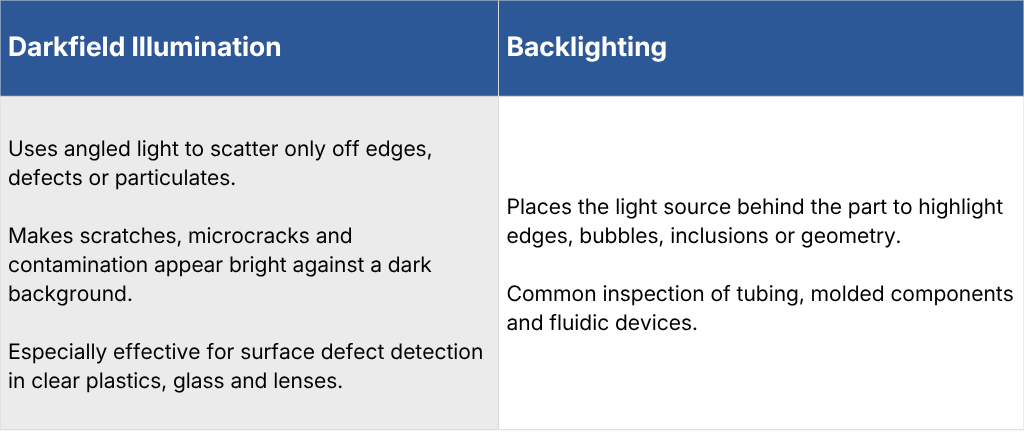
Beyond these characteristics, OEMs must choose the right illumination technique, such as darkfield, brightfield or backlighting to optimize contrast for the specific inspection task, material and defect type. Learn more about illumination methods per application.
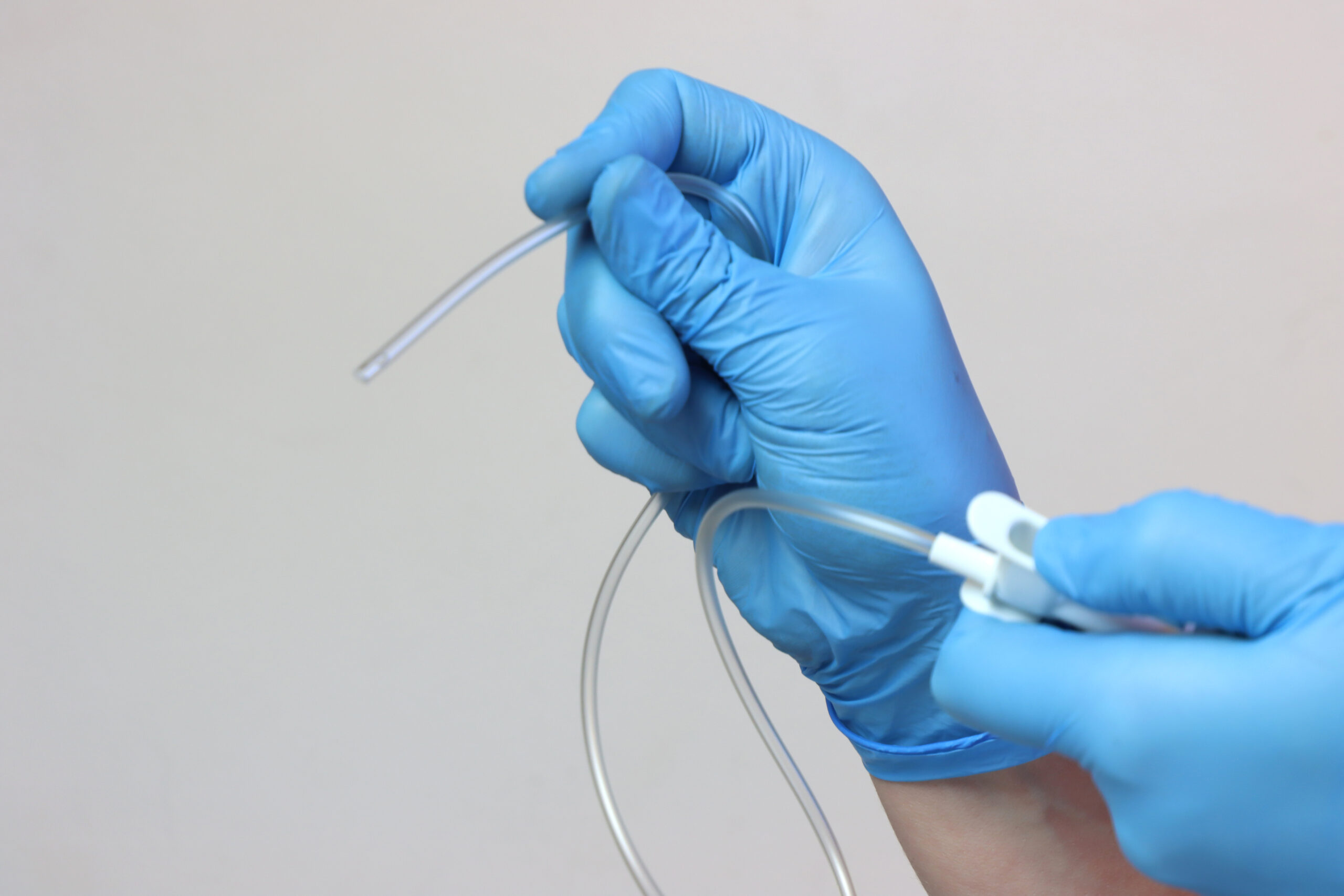
What illumination approach improves contrast for transparent medical components?
The optimal approach depends on whether you are trying to detect surface defects, internal contamination, dimensional features, or stress patterns. For Medical Device QA Inspection, the most effective inspection systems often combine multiple illumination modes. A common strategy is:
- Darkfield → surface scratches, particles, contamination
- Backlight → dimensional inspection, bubbles, internal defects
- Diffuse illumination → cosmetic inspection
- Polarized illumination → stress and molding defects
This aligns well with TechniQuip’s strengths in high-uniformity LED illumination, multi-angle darkfield lighting, precision backlighting, and application-specific illumination architectures designed to deliver repeatable, validated inspection results in regulated medical manufacturing environments.
If the defect is on the surface, use darkfield. If the defect is inside the part, use transmitted backlighting. If glare is the problem, use diffuse or polarized illumination.